Perceptions of Police

“It is the common people’s duty to police the police.” -Steven Magee

It is a well-known fact that people do not necessarily like police officers, especially minority groups. However, with all of the complaining about how police officers are, we should look for a solution.

Two studies conducted by Nadal et al. (2017) found that African Americans held less favorable perceptions of police officers than any other minority group. Researchers assumed this may be due to stereotypes about African Americans leading to more violent discrimination and microaggressions than other minority groups. However, African Americans would not be to only ones affected by these instances of discrimination. According to a study by McNeeley & Grothoff (2016), people who perceive their neighborhoods as having racial tension also have less favorable perception of the police. This means that racial tension affects the perception of police from all groups. With all of this in mind, how can we as a society improve perceptions of the police?

After talking to various professors and students about the issue, I have heard a few common answers. Many professors believe that if police officers were more involved in their communities when it doesn’t relate to crime, that could improve the community’s perception of their local police force. However, many students believe that police officers should be trained better to avoid conflicts that could be seen as racially driven. The only problem that I see with this solution is that police officers would begin treating minorities better than Caucasians simply because of their ethnicity. This would obviously lead to backlash from the white community. I think that having police officers more involved in their communities when it does not involve crime would be the simplest way of opening the eyes of the public. However, I am sure that there are many other solutions out there. Either way, these perceptions of the police need to be improved if we are to reduce crime rates and violence across the country. Improving perceptions would be the first step.

Those are my Thoughts for Food.

McNeeley, S., & Grothoff, G. (2016). A multilevel examination of the relationship between racial tension and attitudes toward the police. American Journal of Criminal Justice : The Journal of the Southern Criminal Justice Association,41(3), 383-401. doi:10.1007/s12103-015-9318-2

Nadal, K., Davidoff, K., Allicock, N., Serpe, C., & Erazo, T. (2017). Perceptions of police, racial profiling, and psychological outcomes: A mixed methodological study. Journal of Social Issues,73(4), 808-830. doi:10.1111/josi.12249

Schafer, J. A., Huebner, B. M., & Bynum, T. S. (2003). Citizen perceptions of police services: Race, neighborhood context, and community policing. Police quarterly, 6(4), 440-468.
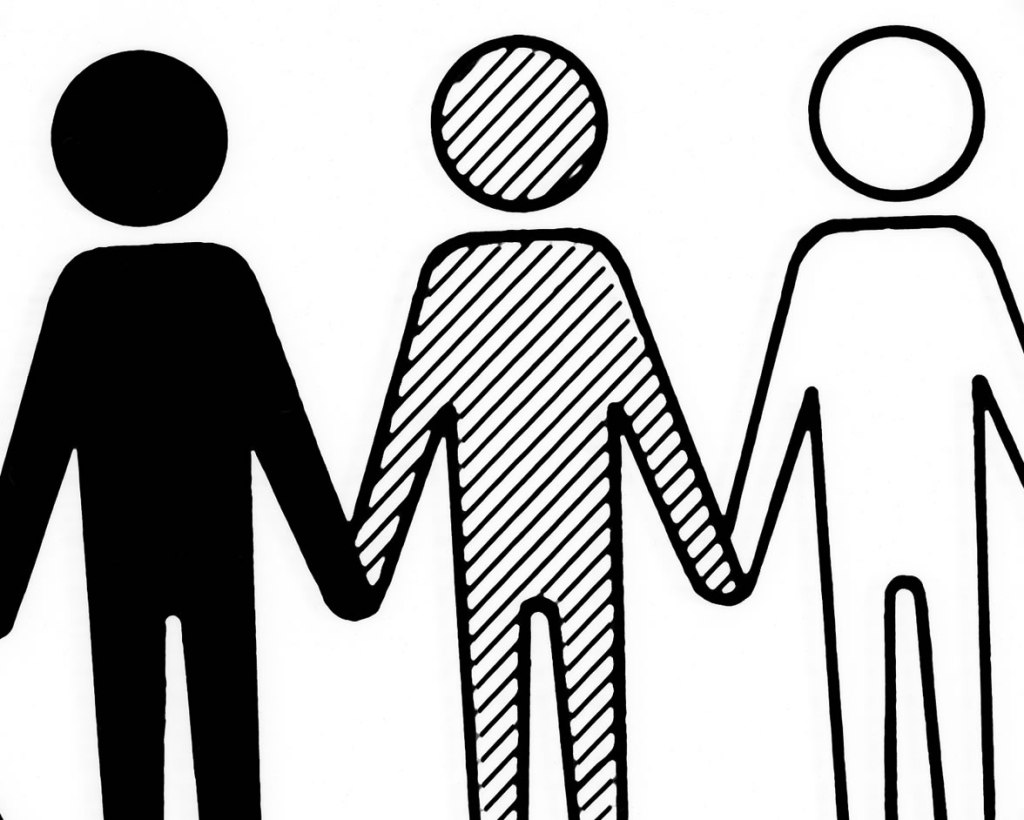
Race?

“I have a dream that my four little children will one day live in a nation where they will not be judged by the color of their skin but by the content of their character.” -Martin Luther King Jr.

Throughout our entire lives, we have been taught about the history of our nation, including the parts about racism, segregation and prejudice. We learned about race and the differences between different races. We also learned that we should take pride in the race that we belong to, encouraging positive stereotypes and avoiding negative ones. However, instead of embracing our ‘race,’ why don’t we embrace our ethnicity or our nationality?

After completing a semester in an introductory sociology course, I would not consider myself an expert on the topic, but I learned much information concerning inequality and differences between peoples. One major section of the class was that race is a social construct. In other words, it is a concept that society created to organize people into categories. This is similar to religion or marriage. It is a way of differentiating between peoples, but this way of identifying people became much different after slavery occurred, making certain races stereotyped as superior and others as inferior.

I strongly believe that it is important to know your history, regardless of how bad it was. However, instead of teaching children to embrace their race, which is completely determined by the color of their skin, why can’t we embrace our ethnicity? By knowing which specific country we come from, we can embrace those cultures and not think of ourselves as superior or inferior to other people. Instead, we can understand that different people have different traditions and come from different cultures. However, if one does not know where their family came from or they are such a mix of things that it is hard to determine, embracing America would not necessarily be a bad thing either. I think that by embracing your roots or embracing the country you live in, we could limit the amount of racism in the country, but something has to change.

The color of our skin should not determine what traditions we follow or define our personality. Everyone is different and has different traditions. The concept of race and the history that accompanies it has only led to discrimination from all ends and hurtful interactions between all groups. By not encouraging the concept of race, we can turn race from a reality to a page in a history textbook.

Those are my Thoughts for Food.

We Are The Human Race

As many years have passed, Race has become increasingly important in multiple areas. Although race played a large role in someone’s future during the 1700’s, race continues to effect how one should lead their life.

In my sociology class, we learned that race is simply a social construct. It is a way of categorizing people based on their physical appearance and has been used as a predictor of one’s reliability and value. Since our physical appearance is based on genetics, no one should be judged based on this. After traveling to Cuba, I saw that Race was nonexistent in the Caribbean. People are treated equally and judged based on their past performance rather than their phenotypic traits. This type of behavior should be adopted Be America, but it seems as though America was the first to implement racism (I could be wrong).

With all the discussion about race and identity, I think that it would be important to acknowledge each other as part of the human race. We are the same and we should all be treated as equals. If we can learn to accept one another for who we are, we could create a better sense of community in the United States and promote equality across the world. In my opinion, this would be very hard to achieve but it is a cause that I would be willing to put my effort towards.

Those are my Thoughts for Food.